Red Light Therapy Benefits for Skin: A Refined Guide
There is something quietly compelling about red light therapy. Not because it promises instant transformation—but because, when understood and used well, it supports the skin in a way that feels both subtle and cumulative. Less about dramatic change… and more about steady renewal. It has, over time, moved from clinical settings into at-home rituals. And with that shift has come a mix of curiosity, enthusiasm, and—understandably—some confusion.
So what does it actually do?
And more importantly, how do the benefits of red light therapy for skin actually show up over time?
For many, understanding red light therapy benefits for skin becomes less about following trends—and more about choosing something that works in harmony with the skin itself.
Understanding Red Light Therapy Benefits for Skin
Red light therapy works by delivering specific wavelengths of light—typically in the range of 630 to 850 nanometers—into the skin.
At this depth, the light interacts with the mitochondria, often referred to as the energy centers of our cells. When stimulated, these cells can produce more adenosine triphosphate (ATP), which supports cellular repair and regeneration. In simpler terms, it helps the skin function more efficiently.
As a result, the benefits of red light therapy for skin may include:
- Support for collagen production
- Improved skin tone and texture
- A softening in the appearance of fine lines
- Enhanced healing and recovery
At the same time, it’s important to understand what it does not do.
It does not exfoliate.
It does not tighten instantly.
And it does not create overnight change.
Instead, it works quietly—beneath the surface—supporting the processes that allow the skin to appear healthier over time.
A Different Kind of Result
Because of this, red light therapy can feel underwhelming at first. There is no tingling. No visible peeling. No immediate lift. However, with consistent use, something more subtle begins to take shape.
The skin appears more even.
More rested.
More responsive to care.
Over time, this is where the true value of red light therapy benefits for skin becomes more noticeable—not in a single moment, but in the way the skin gradually improves.
This is the difference between forcing a result…
and supporting one.
And for many, that shift in expectation changes everything.
Where It Fits Within a Ritual
Within the Radiance Tools approach, red light therapy sits firmly in the Stimulate & Renew category.
It’s not something that replaces your routine—but something that enhances it.
For example, it is best used on clean skin, a few times per week, allowing the light to reach the surface without interference. Sessions are typically short—around ten to twenty minutes—making it easy to integrate without disruption.
Over time, it becomes a quiet moment within the day.
A pause.
A reset.
A small, consistent act of care.
And in that way, it becomes more than a tool.
It becomes part of a rhythm that supports long-term results.
Choosing a Device Thoughtfully
Not all devices deliver the same experience, and understanding this can make a meaningful difference. When considering red light therapy benefits for skin, the effectiveness of the device matters, but simplicity still plays an important role.
A few things to look for:
- Wavelengths in the red (around 630–660 nm) and near-infrared range (around 810–850 nm)
- Even light distribution across the treatment area
- A comfortable, easy-to-use design that fits naturally into your routine
At the same time, it’s helpful to avoid overcomplication. Devices with excessive features or unrealistic claims often create more distraction than benefit. Instead, a well-designed, simple device used consistently will provide better long-term support. Consistency, more than intensity, is what allows the benefits of red light therapy for skin to develop over time.
For those looking to incorporate this into a home routine, there are a range of thoughtfully designed options available—from simple handheld tools to more advanced formats. Choosing one that feels easy to use and aligns with your routine will always be more valuable than choosing one that feels impressive but rarely used.
Understanding Device Types
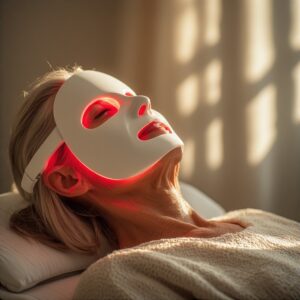
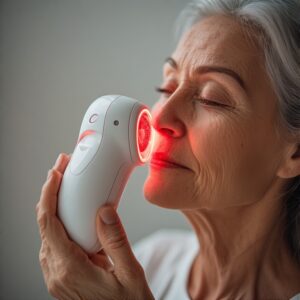
As red light therapy has become more accessible, the range of devices has expanded. Handheld tools are often the most approachable, designed for targeted use and easy integration into a daily or weekly routine. They allow for precision and tend to feel more aligned with a slower, intentional approach. At the same time, larger devices—such as masks and panels—have become increasingly common. Masks are designed to sit directly on the face, offering full coverage in a single session. Panels, on the other hand, are typically used at a short distance and can treat larger areas of the skin. Each format has its place.
However, the effectiveness of red light therapy does not come from the size or complexity of the device—but from the consistency of use and the quality of the light delivered. For many, starting with a simple handheld device allows the practice to become familiar and sustainable. From there, other formats can be explored if they feel supportive.
Pairing with Supportive Skincare
Red light therapy works best when the skin is supported, not overloaded. After a session, the skin is often more receptive. Because of this, it becomes an ideal time to apply ingredients that help maintain hydration and balance. One of the simplest and most effective options is raw honey. Used as a short, gentle mask, honey helps draw moisture into the skin while supporting a soft, balanced finish. Apply a thin layer to clean skin, allow it to rest for several minutes, and then rinse thoroughly with warm water. In this way, the skin benefits from its natural humectant properties without leaving any residue behind. This type of pairing enhances the overall experience while allowing the benefits of red light therapy for skin to continue without interruption. To learn more on honey’s benefits, check out my post: Sweet Science: Honey Benefits Mature Skin at Every Age, a part of my Heritage Ingredients Series.
Is It Worth It?
Red light therapy is not a miracle. It will not replace professional treatments, nor will it dramatically alter the skin overnight. However, when used consistently, it can support the skin in a way that feels sustainable and balanced. The improvements are subtle, but meaningful.
Gradual, not forced.
Supportive, not aggressive.
And over time, this is where many begin to see the true value in red light therapy benefits for skin, not as a quick fix, but as a long-term addition to a thoughtful routine.
A Final Thought
In a space that often prioritizes speed and visible transformation, red light therapy offers something different.
It asks for consistency.
It asks for patience.
And in return, it offers support.
Not just for how the skin looks, but for how it functions.
And that, more than anything, is what allows radiance to develop in a way that feels lasting.
Used thoughtfully, it becomes less about the device… and more about the rhythm it creates.
Explore the introduction to this series here.
#RedLightTherapy #SkincareRitual #RadiantSkin #BeautyTools #SkinWellness #TimelessBeauty
* As an Amazon Associate, I earn from qualifying purchases. Click the images or the product links to shop the products that I recommend and love! Thank you for your support! *
#affiliate #CommissionsEarned